Saturday, October 10, 2009

Chapter 5. The government economic policy objectives and indicators of national economic performance.

Key performance indicators.

1)      Economic growth – in the short run, an increase in real GDP, and in the long run, an increase in productive capacity, that is, in the maximum output that economy can produce.

2)      Unemployment – a situation where people are out of work but are willing and able to work. All people, who are able to work (employed or unemployed) are called labour force. They are economically active. People of working age who are neither employed nor unemployed are called economically inactive.

3)      Inflation – rising in general price level.

4)      Deflation – a sustained fall in general price level.

5)      Balance of payments – a record money flows coming in and going out of a country.


Objectives of government economic policy.

1) Economic growth.

Economic growth is very important for government, who also are trying to achieve economic growth. If the government do it well, there is sustainable economic growth. It means economic growth that can continue over time and does not endanger future generations’ ability to expand productive capacity. The first type of sustainable economic growth is when increasing in aggregate supply match increases in aggregate demand. How can government achieve growth? By matching trend growth. It means  expected increase in potential output over time. It is measure of how fast the economy can grow without generating inflation. A good example of a possible source of sustainable economic growth can be wind firms.

2) Employment and unemployment.

The government also seek to high employment and low unemployment. Some governments state that their objective is full employment, that means a situation where those wanting and able to work can find employment at the going wage rate. But don’t be confused with full employment, because it doesn’t mean that unemployment equals zero, because there is always unemployment near 3 percentages in economy (because some people are loosing their jobs and looking for another everyday).

3) Inflation.

As we know from last chapter, inflation is rising in price level. The government doesn’t want to make inflation zero, the government seeks to low inflation, because low inflation can bring advantages. For example, it may enable firms to reduce their prices by not increasing wages in line with inflation rather that by making some workers redundant.

4) Balance of payments.

The government seeks to avoid current account deficit, when more money is leaving the country that entering, as result of sales of its exports, income and current transfers from abroad being less that imports and income and current transfers going abroad.

5) Economic stability.

6) Income redistribution.

The government can do this by transferring some income from the rich to the poor (by providing special taxes, for instance).


GDP and real GDP.

Economists always measure economy by nominal GDP ( output measured in current prices and so not adjusted for inflation.)


Measuring economic growth.

Economic growth is usually measured by the annual percentage change in real GDP.


Production and productivity.

Labour productivity – output per worker hour. If productivity rises by more than wages, then labour costs will fall and the country can become more price competitive.


Difficulties in interpreting changes in Real GDP.

One problem of interpretation is that the rise in output may be exceed by a rise in population.

Another problem is informal economy (economic activity that is not recorded or registered with the authorities in order to avoid paying tax or complying with regulations, or because the activity is illegal.


Measuring unemployment.

This can be measured by unemployment rate.

Formula: the unemployed x 100% / labour force

In the UK there are two preferred measure: Labour Force Survey (LFS) – a measure of unemployment based on e survey using the ILO definition of unemployment; and The International Labour Organisation (ILO) – a member organization of the United Nations that collects statistics on labour market conditions and seeks to improve working conditions.

Claimant count – a measure of unemployment that includes those receiving unemployment-related benefits.


Measuring inflation.

Inflation can be measured by Consumer Price Index (CPI) – a measure of changes in the price of representative basket of consumer goods and services. Differs from the retail price index (RPI) in methodology and coverage.

And also by Retail Price Index (RPI) – measure of inflation that us used for adjusting pensions and other benefits to take account of changes in inflation and frequently used in wage negotiations. Differs from the consumer price index (CPI) in methodology and coverage.


The structure of the current account of the balance of payments.

Current account includes trade in goods, trade in services, income and transfers. Trade in goods records the earnings from exports and the expenditure on imports. Trade in services, for instance, includes travel, insurance, financial and computer and information services. This part of current account sometimes called invisible balance (because we can’t see services). The income part includes investment income. Transfers cover the transfer of money made and received by government and individuals.


The causes of economic growth.

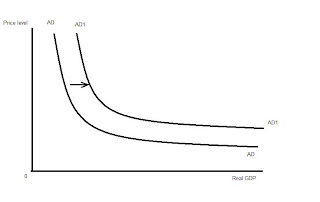
One of the causes is increase in AD (aggregate demand). Economic growth can also be caused by a cut in income tax or a rise in consumer confidence. All this changes can occur in the short run. We can show AD increasing on the diagram below.


Economic growth for long term can be caused by increases in quantity and quality of resources. The main causes of this is advanced technologies or improvements in education and training. Diagram below shows economic growth with increase in AS (aggregate supply)


The causes of unemployment.

We can look at cause from two different sides (changes in demand and changes in supply).

Cyclical unemployment – unemployment arising from a lack of aggregate demand.

Structural unemployment – unemployment caused by the decline of certain industries and occupations due to changes in demand and supply.

Frictional unemployment – short term unemployment occurring when workers are in-between jobs. Actually, these people have just dropped their jobs and looking for other jobs.

The causes of inflation.

As we know inflation is price growing. Therefore inflation is caused by changes in prices. Price can be changed, because of changes in aggregate demand and changes in cost of production. So we have two types of inflation:

-          Demand-pull inflation – increases in price level caused by increases in aggregate demand.


-          Cost-push inflation – increases in price level caused by increases in cost of production.    


Deficit in the current account of the balance of payments.

When expenditure abroad is greater that income from abroad.

There are two main causes of deficit:

-          because the country’s inhabitants have spent more on goods and services from abroad than residents have spent in the country’s products or services.

-          because there has been a net outflow of investment income

Another causes: changes in income at home and abroad, changes in exchange rate and structural problems.


Surplus in the current account of the balance of payments.

When the country’s revenue form abroad is greater than expenditure abroad.

It can be when the quantity of country’s product is high and the cost of production is low (so expenditure will rise), also when there is a recession in the country ( import will decrease because people won’t be willing to but some products during a recession)


The consequences of unemployment.

      -    lost output. Having people who are ready to work is a waste of resources (labour). On the diagram below we can that real output is below potential output because of non-full using resources (labour).


-          lost tax revenue. It is when real value of taxes is lower than potential. When people are working, the government receive more taxes, because people are earning more and spending more.

-          government spending on unemployment benefits. The problem is that the government has to spend more on unemployment benefits with rising un. rate. Instead of spending on another areas, such as health, communication, education, etc. (opportunity cost!)

-          hysteresis. This means unemployment can causing unemployment. And it also can caused long- term unemployment (for mare than one year).  


The benefits of unemployment.

-          for some people it may give more time to search a new job.

-          it also makes easier for firms to find workers.(exactly they need)

-          reducing inflation. (people will buy less with less income)


The consequences of inflation.

-          Fall in value of money. With rising in price people will spend less, so the value of pounds will decrease.

-          Menu cost – the costs of changing prices due to inflation.

-          Shoeleather costs – costs in terms of the extra time and effort involved in reducing money.

-          Administrative costs.

-          Inflationary noise – the distortion of price signals caused by inflation.

-          Random redistribution of income. Some people will lose their money and some people will earn. So there will be a big gap between rich and poor people.(like in Ukraine, where there is a hyper inflation).

-          Fiscal drag – people’s income being dragged into higher tax bands as a result of tax brackets not being adjusted in line with inflation.  

-          Uncertainty. When firms are not certain  about their costs in the future and also people are not certain about prices in the future.

-          Inflation causing inflation.

-          Loss of international competitiveness.


The benefits of inflation.

If the salaries are rising too during inflation, workers will be satisfied, even prices are growing. Also firms will increase their output, because aggregate demand will increase ( if it is demand-pull inflation). It will probably involve more places for unemployment, because firms will have to extend their production to increase their output.


Deflation – decreasing in price level.


The consequences of a deficit and a surplus on the current account of the balance of payments.

Deficit – raise unemployment; reduce economy’s output; fall in the exchange rate; less pressure on price level.

Surplus – increase in bank lending; growth in exchange rate; increasing in aggregate demand.


The costs of economic growth.

The graph below shows the opportunity cost of  economic growth (capital goods instead of consumer goods)


The benefits of economic growth.

1)      A rise in people’s material standard of living.

2)      Economic growth enables poverty within a country to be reduced without having to redistribute existing income.  

3)      A rise in the level of a country’s real output.

International Monetary Fund (IMF) – an international organization that helps co-ordinate the international monetary system.

World Trade Organization (WTO) – an international organization that promotes free international trade and rules on international trade disputes.


Exchange rate

Exchange rate – the price of one currency in terms of another currency or currencies.

Monetary Policy Committee (MPC) – a committee of the Bank of England with responsibility for setting the interest rate in order to meet the government’s inflation target.

Factors affected the exchange rate:

1)      An increase in demand for pounds.


2)      An increase in supply for pounds.


3)      Changes in income abroad.

4)      Changes in income in the country.

5)      Speculation – buying and selling currency ( very common in Ukraine).


The relationships between the exchange rate and the interest rate.

Exchange  rate is rising – interest rate is falling.

A reduction in interest rate – reduction in exchange rate.


The effect of a change in the exchange rate on export and import prices.

SPICED – strong pound import cheap export dear (expensive)!!!!!!!!!


Changes in the exchange rate and the macroeconomy.

The possible effect of a lower exchange rate on the economy is showed on the diagram below.


Friday, October 9, 2009

Chapter 6. The application of macroeconomic policy instruments and the international economy.

Demand-side policies.

Fiscal policy. It includes taxation and spending decisions of a government. The government can change tax rates, the types of taxes it imposes and what it taxes, amount and timing of government spending. The main aim of fiscal policy is to influence Aggregate Demand (AD).

Increasing government spending and reduction taxes – increase in AD.

Rises in government spending and cuts in taxes designed to increase AD are referred to as reflationary (aim – increase AD), expansionary or loose fiscal policy.  In contrast, deflationary (aim – decrease AD), contractionary or tight fiscal policy involves measures that reduce AD, that is, cuts in government spending and/or rises in taxes.

The nature of fiscal policy.

The main target of the government is to influence AD to match AS and so avoid both unemployment and inflation. This objective can be achieved by using what is called discretionary fiscal policy (deliberate changes in government spending and taxation designed to influence aggregate demand) or allow automatic stabilisers (forms of government spending and taxation that change automatically to offset fluctuations in economic activity) to operate. Not all forms of government spending and taxation are automatic stabilisers. For instance, spending on child benefits is not linked to the economic cycle (this is the tendency for economic activity to fluctuate its trend growth rate, moving from a high level of economic stability to negative economic growth.)

Types of taxes.

The most imposed tax in the UK is income tax. Income tax is a direct and progressive tax( higher percentage from the income of the rich). Another tax is VAT (value added tax). This is an indirect tax and largely regressive tax ( grater percentage from the income of the poor). Other taxes include excise duty, capital gains tax, corporation tax and inheritance tax.


Government spending

- Capital expenditure – e.g. hospitals, schools, roads.

- Current spending – public services (e.g. teachers´ pay)

- Transfer payments – money transferred from taxpayer to recipients of benefits (e.g. pensioners and unemployed)

- Debt interest payments – money transferred from holders of government debt (e.g. interest paid to holders of National Savings certificate)

The five most important individual areas of government spending in the UK recently have been social protection, health, education, defence and debt interest.


The budget. The budget position shows the relationships between government spending and tax revenue. When the two are equal it means that the budget is balanced.

Government spending exceeds tax revenue – budget deficit.

Tax revenue exceeds government spending – budget surplus.


Monetary policy.  Includes the rate of interest, the money supply and exchange rate. The most used instrument of monetary policy is interest rate. A higher interest rate tends to reduce consumption and lower firms` investment. This is also likely to encourage foreigners to place more money into UK financial institutions because of their higher return. This would rise  demand for pounds, which  would push up the value of the pound. A higher exchange rate will make exports more expensive and imports cheaper. This is likely to reduce net exports. So, a rise in the interest rate is likely to decrease AD by reducing consumption and investment. Money supply can also be used to influence AD. An increase in money supply is likely to increase AD. If the government prints more money( devaluate ) or makes it easier for banks to lend  money, people will have more money to spend. Changes in money supply and interest rates are inversely related. A rise in the money supply, by increasing the amount that banks have to lend, reduces the interest rate.


The monetary policy committee.

The monetary policy committee (MPC) of the Bank of England sets the rate of interest with the main objective of achieving the government’s target annual rate of inflation of 2%, as measured by the consumer price index.


Supply-side policies.


Education and training. The government encourages firms to increase their training, that should raise the occupational mobility of labour and labour productivity. This will shift AS curve to the right.


Government assistance to new firms. The government  helps new businesses establish by  providing them with grant and low corporation tax.


Reduction in direct taxes. A cut on direct taxes such as corporation tax would increase incentives to firms, workers and potential workers, which would lead to increase in AS.


National minimum wage (NMW) . By providing a high NMW the government could encourage people to enter the labour market, that tends to increase in AS.


Reduction in unemployment benefit. A reduction in job seeker’s allowance the government would encourage unemployed to enter the labour market, that tends to increase in AS.


Reduction in other benefits. The government could reduce other benefits for those who are economically inactive.


Reduction in trade union power. This may cause either an increase in the efficiency in labour markets if a reduce in employment by pushing wage rates above the equilibrium level causes people to engage restrictive practices. But this can also work the other way if it helps labour markets work efficiently.


Privatisation. Some economists argue that there should be more power in the private sector because they believe private sector firms are in the best position to make decisions about what to produce, how to produce and what to charge. On the other side it is argued that government ownership of firms is beneficial in a number of cases where there is a high risk of market failure.


Deregulation: Deregulation is the removal of rules and regulations that affect firms in the belief that will give the firms greater freedom to make their own decisions and to increase competition by making it easier for new firms to enter an industry.


Policies to reduce unemployment.


Demand-side policies.

Expansionary fiscal and/or monetary policy can be used to create jobs. A government by using fiscal policy could increase its spending and/or cut taxes in order to raise AD. Increases in money supply or lower interest rates are also likely to raise AD. For instance, a fall in interest rates and/or an increase in the money supply should stimulate consumption and investment. It may also raise net exports if it causes a fall in the exchange rate.


Supply-side policies.

Supply-side policies can be used to increase economic incentives and the quality of labour services offered by the unemployed. The quantity and quality of information available to the unemployed about job vacancies and to employers about those seeking jobs can be increased. Improved education and training and the provision of work experience may raise the skills of the unemployed. Greater provision of low-cost child-care may enable more lone parents to work. Legislation and the subsidising of special equipment and adaptation of buildings may facilitate the employment of more disabled workers.


Policies to control inflation.


Cost-push inflation.

A government may try to reduce firms’ cost by reducing corporation tax. This will also have the advantage of stimulating investment.

A government also can provide subsides that would help firms to cover their cost, that lead to falling in prices. There is a danger that the firms may become reliant on subsidies and do not strive to keep their costs down.


Demand-pull inflation.

To reduce inflation a government may use deflationary fiscal and/or monetary policy instruments. These are ones that seek to reduce AD or at least a growth in AD by raising income tax, for instance.


Inflation targeting.

This can lower both cost-push and demand-pull inflation by reducing expectations of inflation. If people are convinced that a central bank has the determination, experience and ability to meet its target, they will act in a way that does not cause inflation. In the long run, a government is likely to seek to reduce the possibility of inflationary pressure by increasing AD. If the productive capacity of the economy grows in line with AD, with rightwards shifts in the AD curve being matched by rightwards shifts in the AS curve, the economy can grow with the price level rising. To ensure the quantity and quality of resources rise to supply more products, supply-side policies may be used.


Policies to promote economic growth

Short run.

Increases in output in the short run can occur due to increases in AD if the economy is initially producing below full capacity. Such an increase may be stimulated by expansionary or fiscal policy. Some monetary and fiscal policies have the ability to change both AD and AS. For instance, a lower rate of interest is likely to stimulate both consumption and investment.

Long run.

In the long run, increases in the country’s output can continue to be achieved only if the productive capacity of the economy increases. This is why AS is so important. For instance, measures that raise investment will increase AS. The extent of increase will depend on the amount of extra investment, its type, and how efficiently it is used. A way to increase  the productive capacity of the economy is through investment in human capital. Human capital is education, training and experience that a worker, or group of workers, possesses.

Stable growth.

Stable growth is for actual growth to match trend growth and for that trend growth to rise over time. Governments try to avoid AD increasing faster than the trend growth rate permits, since this can result in the economy overheating with inflation and balance of payments problems arising. They also try to prevent AD rising more slowly than the trend growth rate, since this would mean a negative output gap developing with unemployed resources. In other words, governments seek to avoid economic cycles.


Policies to improve the balance of payments

There are several policy instruments a government can use to improve its balance of payments position.

Short run

Exchange rate adjustment.

A country may want to reduce the exchange rate if it believes that its current level is too high and as result is causing its products to be uncompetitive against rival countries` products. A lower Exchange rate will cause export prices to fall and import prices to rise. To succeed in increasing export revenue and reducing import expenditure, it is important that demand for exports and imports is price elastic, that other countries do not devalue and do not increase any import restriction.

Deflationary demand management

To discourage expenditure on imports, a government may adopt deflationary fiscal and monetary policy instruments. Higher tax, lower government spending and/or higher interest rates may reduce domestic spending. The risk is that a reduction in spending may cause aggregate output to fall and unemployment to rise.

Import restrictions

A country may seek to reduce expenditure on imports by imposing import restrictions including tariffs (tax on imports) and quotas (a limit on imports). However, these measures may inflationary side-effects. For instance, imposing tariffs will increase the price of some products bought in the country, raise the cost of imported raw materials and reduce competitive pressure on domestic firms to keep costs and prices low.

Long run

The most appropriate approach to long-run solutions would be to implement supply-side policies. How successful supply side policies are depends on the appropriateness of the policies.

Current account surplus

A disequilibrium may also arise because of a current account surplus. A government may seek to reduce or eliminate a surplus in order avoid inflationary pressure and to raise the amount of imports it can enjoy. To reduce it a government may seek to raise the value of its currency, introduce reflationary fiscal policy and monetary instruments and/or reduce imports restricitons.


Effectiveness of fiscal policy


Advantages

Number of taxes and forms of government spending adjust automatically to offset fluctuations in real GDP.

Some forms of government spending and taxation, including cuts in corporation tax and training grants, have the potential to increase both AD and AS.


Disadvantages

It takes time for government spending and tax to affect the economy and it takes time to recognise the need for a change in policy and at which base to change.

There is an time lag between introducing fiscal policy instruments and that instrument having an impact on the economy.

Number of government spending is inflexible (e.g. difficult to cut spending on health care and pensions).

Need to be based on accurate information (e.g. radio predict recession might lead to a change in expectations)

Households and firms may react in unexpected ways (e.g. cut in income taxes may not lead to higher consumption and investment if households and firms lack confidence).

May have an adverse effect on incentives and other macroeconomic objectives. (e.g. rise increase in state benefits may discourage some people from working).

Can be offset by changes in the economic activity in other countries.


Effectiveness of monetary policy


Disadvantages

Can be difficult to control the policy instruments (e.g. keep inflation in check by controlling the money supply)

The use of interest by MPC may be overestimating the prospects of inflation and so keeping the interest rate too high and limiting economic growth.

Take time for interest rate to work through the economy.

The interest rate may not change the AD s much as expected (e.g. if people are optimistic about the future, they may not reduce spending even after a rise in the interest rate).

A central bank’s ability to change its interest rate may be limited by the need for it to remain in line with other countries` interest rates (noticeable difference may cause inflow or outflow of hot money flows, which can disrupt financial markets).

When interest rates falls to very low levels, a further cut is likely to be ineffective in stimulating economic activity.

If interest rates is low when inflation is low and stable, it may not have big effect on the economy to change the interest if there is an increase in inflation.

Tend to be more concentrated on certain groups (e.g. rise in interest rate will hit firms that export a high proportion of their output more than it will affect other firms).

May have undesirable side-effects. A rise in the exchange rate, designed to reduce inflationary pressures, may worsen the balance of payments position.


The effectiveness of supply-side policies

Economists agree that if the supply-side performance of the economy can be improved, it may be easier for a government to achieve its objectives. However, increasing the productive potential on its own will not be sufficient in raising economic performance if there is a lack of AD.

Some supply-side policies take a relatively long time to have an effect, they can be exoensive to operate and there is no guarantee that they will work.


Possible conflicts between policy objectives


The objectives of economic growth and low unemployment may benefit from expansionary demand-side policy measures. In contrast, such measures may make it more difficult for a government to achieve low inflation and a satisfactory balance of payments position.

MPC may face a conflict when setting the interest rate because it may want to raise interest rate to reduce inflationary pressure but be concerned about the effects such a move will have on the exchange rate and so on the balance of paymenst and employment.


Advantages that may be gained from international trade

International trade involves the exchange of goods and services across national borders. These are the benefits from international trade:

lower prices and high quantity because of high competition

greater variety of products

high competition leads to firms accessing larger markets in which to sell their products and buy raw materials.

There are some challenges with international trade as well. Competition from other countries and access to their markets result in some industries contracting and some expanding. This requires the shifting of resources, which can be unsettling and may be difficult to achieve due to, for example, occupational immobility of labour (difficulty in moving from one type of job to another).

What also happens in international trade is that some countries put restrictions on the exports of certain products if they become in short supply.


Methods of protection


International free trade occurs when there are no restrictions imposed on the movement of goods and services into and out of countries. In contrast protectionism results in the deliberate restriction of the free movement of goods and services between countries and economic blocks. A government engage in protectionism when it introduces measures to protect its own industries from competition from the industries of other countries.


Tariffs.

Tariffs are taxes on imported products.

Quotas.

This is a limit of supply of a good or service.

Voluntary export restraint.

Voluntary export restraint (VER) is a limit placed on imports from a country with the agreement of that country’s government.

Foreign exchange restrictions.

Governments may seek to reduce imports by limiting the amount of foreign exchange made available to those wishing to buy imported goods and services or to invest or to travel abroad.

Embargoes.

An embargo is a ban on the export or import of a product and/or a ban on trade with a particular country.

Red tape.

Time-delaying procedures may be used to discourage imports.

Other measures.

Two additional measures are quality standards and government purchasing policies. Quality standards may be set high and complex requirements may be put in place with the intention of raising the costs of foreign firms seeking to export to the country. A government may also try to reduce imports by favouring domestic firms when it places orders.

Thursday, October 8, 2009

ECONOMICS are EVERYWHERE......

COMING SOON ON BLOG!!!!!!!!!!!!!!!

Tuesday, October 6, 2009

I have read a book ' More sex is safer sex' by author Steven Landsburg.  He maintains that if more people, especially more sexually conservative people, had sex the AIDS  (virus)  epidemic could be reduced. As I understood this idea, author mens that if people, who are in couple (married or just a boyfriend and a girlfriend) will have more sex, the rate of the AIDS' people would fall, because it would be less current sex relationships. I mean if a men, for example, can have sex at home with his wife, he, probably, would not go to a bar and take prostitute(which involves current sex and increasing in AIDS' rate). Another  famous person  Elizabeth Pisani did some research in Thailand. She got that now people are having more sex than 20-30 years ago and she thinks that if they will have more sex, the rate of AIDS' people will decrease. 

Sunday, October 4, 2009

Chapter 4. Aggregate demand and aggregate supply and their interaction.

Aggregate demand.

Aggregate demand is the total demand for a country’s goods and services at a given price level (the average of each of the prices of all the products produced in an economy) and in a given time period.

It is made up of consumer expenditure _C_(spending by households on consumer products), investment _I_ (spending on capital goods), government spending _G_ (spending by central government and local government on goods  and services), net export (exports _X_ minus import _M_)

 So we have a formula of aggregate demand:

AD = C + I + G + (X – M)


So lets have a look on the components of aggregate demand.


Consumer expenditure (consumption)

There are some things that can have influence on consumption:

-          real disposable income. This is the main influence on consumption. If people have more income they spend more, if they are poor they spend less. This can be measured by average propensity to consume (APC). The formula: spending/disposable income.

-          wealth. Everything that people own ( houses, cars, assets, shares, money in a savings account, etc.) is wealth. It’s very simple to understand. For example, people who have more property or more savings in their accounts will be willing to spend more.

-          consumer confidence and expectations. When consumers are filling optimistic about their future and they also are waiting for increasing their wages, they spend more money.

-          the rate of interest. It is important influence on consumption. Firstly, interest rate is the charge for borrowing money and the amount paid for lending money. For instance, if rate of interest fell, people would borrow more money, thus, they would spend more. But for people who save money for borrowing (net savers) a fall in rate of interest has negative sequels, because they will earn less by lending money than they could before a fall in interest rate. So their spending will reduce. Usually, a fall in spending of net savers bigger than a fall in spending  of ordinary people. That’s why a fall in interest rate can be often a cause of decreasing in spending.

-          the age structure of the population. As we know the young and the elderly spend a high proportional of their disposable income, because these groups of people don’t earn a lot, they usually spend more than their income.

-          distribution of income. It shows how income is shared out between households in a country.

-          inflation. It is a sustained rise in the price level. So, if there is inflation in the country, people are waiting for increasing in prices, thus, they will spend more now (spending will increase).

Talking about consumer expenditure we can also pay attention on saving.

Saving is real disposable income minus spending.

Here is a list of things that have influence on saving:

-          real disposable income. It is measured  by average propensity to save (APS). Formula: saving/ disposable income.

-          the rate of interest ( not a rate of borrowing!). If it increases people will save more. There is also group of people who save with a target figure in mind. They are target savers. In their case high interest rate would reduce the amount they have to save.

-          confidence and expectation. Households and firms are likely to save more if they are not certain about their future. Fro instance, if people expect losing their jobs, they will save more.

-          saving schemes. Some saving are contractual (when people agree to save a certain amount on regular basis in insurance and pension schemes).

-          range of financial institutions. If financial system in the country is stable and developing, people will trust more financial institutions, so they will save more. But sometimes when financial system becomes more developed people will find borrowing money easier so they will save less.

-          government policies. If the government introduce tax-free saving schemes people will save more.

-          the age structure of the population. Yong people don’t usually save money. People often start to save in middle age. They save money for their retirement. In developing countries (effective economic system) it is very popular to save money for pension (after retirement) age.


Investment

The main reason of investment is rewards (for example, percentage of the company). So investors are looking for some factors when they are making decision about investment to make the highest profit. So, what actually can influence on investment:

-          changes in real disposable income. Usually, if income increases, demand will increase. So it is likely for firms to invest in this period. But they have to know that with increasing demand they have to supply more to avoid a highly increase in price. So they will have to invest more.

-          expectations. Firms are likely to invest more if they are optimistic about their future.

-          capacity utilization - the extent to which firms are using their capital goods. Firms are likely to invest more if the have currently operating close to full capacity.

-          current profit levels. High profit level encourage firms to invest more and also encourage firms to be optimistic about their future.

-          corporation tax. This is a tax on firm’s profits. If this tax increases firms will invest less. In contrast, cut in corporate tax would encourage firms to invest more.

-          the rate of interest. Interest rate has high influence on investments, because firms, that invest money into the market, depends on changes in particular market. Changes in interest rate will cause changes in the market ( interest rate rises – people spend less, etc.)

-          advances in technology. With new technologies production  always develop. If firm will involve new technology in production they will, probably, spend less money on producing, so their profit will increase. We can say that new technologies encourage firms to invest more.

-          price of capital equipment. It is very simple. Cheaper equipment – more firms are able to buy – more firms are willing to invest.


Government spending.

Lets have a look at first on two definitions: Real GDP (the country’s output measured in constant prices and so adjusted for inflation) and GDP (the total output of goods and services produced in a country).

Factors, which have influence on government spending:

-          the government’s view on the extent of market failure and its ability to correct it.

-          the level of economic activity in the economy. For example, if it is a high level of unemployment government can increase spending to increase aggregate demand and national output.

-          a desire to please the electorate. The government can spend money on education, health, etc. to prove to their voters that their government works efficiency ( also to attract more people for next election)

-          war, terrorist attacks and rising crime, or their threat, can also increase government spending.

Net exports.

Factors which have influence on net exports:

-          real disposable income abroad. A rise in income abroad is likely to result in more exports being sold.

-          real disposable income at home. In contrast, a  rise in income at home can result a fall in export, because some firms can change their selling policy and sell products at home because they will be certain about demand at home.

-          the domestic price level. The value of exports can fall and a value of imports can increase if the domestic price level rises relative to the price levels in the partner-traders countries.

-          the exchange rate. It is the price of one currency in terms of another currency. Exchange rate is very important in international trade. SPICED. If exchange rate goes up (for instance, pound) import prices will be cheaper, export prices will be more expensive.

-          government restrictions on free trade. The government can provide special payments for imports. It is called tariffs. For example, if you want to sell China steel in the UK, you have to pay tariff.


The relationship between aggregate demand and the price level.

So lets have a look on diagram below.


As we can see that x-axis is Real GDP (GDP after inflation) and y-axis is Price Level). The aggregate demand curve slopes down left to right. There are three effects, that explain this:

-          the wealth effect. This relates to changes in households’ and firms’ wealth.

-          the rate of interest effect. A rise in the price level means that some people will sell financial assets, such as government bonds (a financial asset issued by the central or local government as a means of borrowing money)

-          the international trade effect. A rise in the price level will make international product less competitive, so export will decrease, and people also will start to buy more import. As a result it will be budget deficit (import is greater the export), so demand will contract.


Shifts in aggregate demand curve.

On the diagram below we can see an increase in aggregate demand. There are a lot of reasons of this (we have talked about it before).


Aggregate supply.

What is it? It is the total amount that producers in an economy are willing and able to supply at a given price level in a given time period.

On the diagram below we can see a varying elasticity along an aggregate supply curve. This diagram (from points O and Y) shows situation with a high level of unemployment and low output ( AS is perfectly elastic)


 Shifts in aggregate supply curve.

The main causes of changes in AS in the short run are changes in the costs of production. On the figure below we can see that AS decreases, because of increase in the cost of production, for instance.


Increasing in AS can also be caused by increasing in labour productivity (output, or production, of a good or service per worker per unit of a factor of production in a given time period.). Diagram below shows the productive capacity of the economy increasing.


Macroeconomic equilibrium.

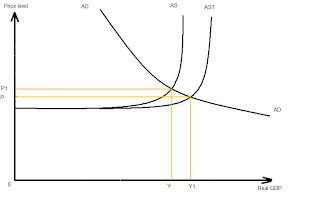
Macroeconomic equilibrium occurs in situation where aggregate demand (AD) equals aggregate supply (AS) and real GDP is not changing.

Example of macroeconomic equilibrium in the point P,Y:


The circular flow of income.

The circular flow of income shows show us how the whole economy works and how changes AD. On the picture below you can see diagram of the circular flow of income.


Factor services – the services provided by the factors of production.

Leakages – withdraws of possible spending form the circular flow of income.

Injections – additions of extra spending into the circular flow.


Multiplier effect...

Is the process by which any change in a component of aggregate demand results in a greater final change in real GDP.

The diagram below shows the increase in AD of 5 billion pounds and the final increase in AD of 15 billion pounds. The main thing of multiplier effect that government has to recognize is that any change in government spending or taxes will have a knock-on effect on the economy.


Changes in aggregate demand.

An increase in aggregate demand raising the country’s output but leaving the price level unchanged.


An increase in aggregate demand raising both the country’s output and its price level


An increase in aggregate demand raising the price level but having no effect on the country’s output.


Changes in aggregate supply.

An increase in aggregate supply increasing the country’s output and lowering the price level.


An increase in aggregate supply raising potential output but having no effect on the country’s output or price level.


Changes in AD and AS.

An increase in aggregate supply matching an increase in aggregate demand.


AD growing more rapidly than AS. This diagram also shows an economy overheating( the growth in AD outstripping the growth in AS, resulting in inflation)   


Output gap.

Output gap – the difference between an economy’s actual and potential GDP. It can be positive and negative.

Positive output gap (actual output is above potential output)


Negative output gap (actual output us below potential output)


Thursday, October 1, 2009

Chapter 3: Market failure and government intervention.

 
As we know that the main aim of market is to produce the best ( efficiency ) allocation of scare resources. In an ideal situation market does it, but in practice markets do not always work in this way. In this case we have the term market failure.
Market failure occurs where the free market mechanism (the system by which the market forces of demand and supply determine prices and the decisions made by customers and firms) fails to achieve achieve economic efficiency. Using simple words, during this process market is failing to produce the best use of scarce resources.
Lets talk about efficiency. There are two recognizable types of efficiency: allocative efficiency (we looked before) and productive efficiency. Economists explain productive efficiency as a process when everything that is produced is produced using the least amount of scare resources. Both terms (allocative efficiency and productive efficiency) are parts of economic efficiency.
What does it mean? Economic efficiency is a process where both allocative productive efficiency are achieved. There also the opposite term of efficiency. Inefficiency. This means any situation where economic efficiency is not achieved (resources are not used in the best possible way)
Information failure.
As we know all people, when they are making decisions what product buy or what product don’t buy, are using some sources of information about particular product (advertisement, for example). So information is very important for people while they are making decisions. We have to remember that almost in all cases people think rational, so they are thinking about advantages and disadvantages of buying something new. Lets have a look on this using some examples.
We can conditionally divide all goods into two groups (merit goods and demerit goods). You have to remember that difference between this two groups of goods is that demerit goods have bad influence for society (for example, cigarettes).
- merit goods

As we can see on the graph without information people would by less than with information. If people will know that product is good (for example, healthy food), they will buy it.


- demerit goods

We can notice from this graph that with information (about how goods are harmful) people would by less.

Speaking about information failure we also should to pay attention on asymmetric information. This means that information nit equally shared between two parties. Lets have a look on partical examples for better understanding:
Health care. When you visit your doctor with illness, you do not have the same medical knowledge as your doctor. You rely on the doctor’s experience and competence to give you treatment you need.
Insurance. When applying for travel or car insurance, as a purchaser you know far more about your circumstances (particular situation) than the company that is selling the insurance.
In these examples we can see that the lack of information has distorted how the market allocates resources.

Externalities.
All production has influence (sometimes positive, sometimes negative). In Economics this calls externality, that means an effect whereby those not directly involved in taking a decision are affected by the actions of others. The group of people, that is affected by others without taking decisions, calls third parties. Lets look at example just for better understanding.
Suppose a new airport was built. Noise from planes is negative influence (externality) on people (third parties) who live in this area.

Lets look at costs and benefits of externality.
There are three types of costs and benefits:
1) Private costs and benefits. In the case with airport, private costs are costs incurred by firm(airport) and privet benefits are directly received by airport. Private costs are the costs incurred by those taking particular action. Private benefits are the benefits directly accruing to those taking a particular action.
2) External costs and benefits. In the case with airport, people who live on the flight path of the airport will experience additional noise pollution problems. They may be forced to soundproof their homes at their own expenses trough no fault or doing of their own. An external benefits could be if some frights transfer to the airport from elsewhere, resulting in less noise pollution for those people who live near airport.
3) Social costs and benefits. You have to remember that external and social costs and benefits are not the same. For example, in the case of airport, the social cost could include cost of increased CO2 pollution, and social benefit might include the additional jobs for people who live in this area (near airport).

Negative externalities.
Negative externality exists where the social cost of an activity is greater than the private cost. Here some examples:
Chewing gum. This can poses major problems in all towns and cities. Westminster Council claims to spend over 100,000 pounds annually removing gum from its streets.
Illegal dumping of waste. The private cost to those dumping such things is minimal (unless they are found out!); the external cost has to be covered by those, such as local councils, responsible for maintaining the environmental.
Each of these situations we can show on the graph below.

The price is P and the quantity bought and sold is Q. At this price the supply curve only takes into account the private costs of a given action. If the external costs is also accounted, the supply curve would shift to the left, to S1. The result would increase in price to P1 and fall in equilibrium quantity to Q1. The problem with negative externality is that there is over-production of Q-Q1 and that the price is lower than it should be. Too many scare resources are being used.

Positive externalities.
Positive externality exists where the social benefit of an activity exceeds (is greater than) the private benefit.
Lets have a look at the graph below.

At the price P the private benefit are not taken into account. If they are, the demand curve will shift to the right and, as a result, the market equilibrium would be at the price P1 and quantity Q1. Where the market fail to operate in this way, there is under-production. This is shown by the difference between Q1 and Q. Too few scarce resources are being used, hence the market failure.

As you remember, we have looked on two types of goods (merit and demerit) before. There is also another group of goods.

Public goods.
Public goods are goods that are collectively consumed and have characteristics of non-excludability and non-rivalry. There are two types of public goods:
1) non-excludability – situation existing where individual consumers cannot be excluded from consumption. Free rider – someone who directly benefits from the consumption of a public good but who doesn’t contribute (develop) towards its position.
2) non-rivalry – situation existing where consumption by one person doesn’t affect the consumption of all others.
Economists also notice a further type of public good – quasi-public good (goods having some but not all of the characteristics of a public good)

Government intervention to correct market failure.
The government can intervene into market by two ways (methods):
1) by manipulation of the market mechanism – subsidies, indirect taxation and the provision of information.
2) by direct provision and various forms of regulation and control.

TAXATION
There are two types of taxes:
- direct taxes, such as income tax, corporation tax and national insurance contributions, all of which are taxes on the incomes of individuals and firms.
- indirect taxes, such as value added tax (VAT) and excuse duties, that tax the sale of certain products, council tax and business rates are charged locally on the ownership of houses and business premises.

SUBSIDIES
Subsidy is a direct payment made by government to producers of a good or service or, in some cases, to its consumers. This company is aimed to reduce the cost and increase level of production and consumption. Lets have a look on some examples:
- subsidies to producers . payments to train-operating companies to operate franchised service, payments to local bus companies to run loss-making services in rural areas, etc.
- subsidies to consumers . the winter full payment to people aged 60 and over, the educational maintenance allowance for 16-18-years-olds in further education,etc.
Lets look on the graph below, that shows us the effects of introducing a subsidy.

As we can see that in almost all situations introducing a subsidy involves an increasing in supply (supply curve shifts to the left)

Regulations, standards and legal controls.
The best way of understanding this topic is looking through some examples in our book.

Tradable permits.
Tradable permits are the permits that allows owner to emit a certain amount of pollution and that, if unused or only partially used, can be sold to another polluter.
The graph below shows how, in theory, the price of permit is determined. As we see that supply of permits (S) is constant(vertical straight line). So if demand will change from D to D1 only prices will change (from P to P1).

Role of government in information provision.
Lets have a look at some examples to understand exactly how the government plays role in information provision:
- health warnings on cigarette packets
- advice on the maximum number of units of alcohol that should be consumed
- improved labeling on food products, such as the ‘traffic light’ system that indicates fat, sugar and salt content
- advice on the consumption of junk food and on links to child obesity.